
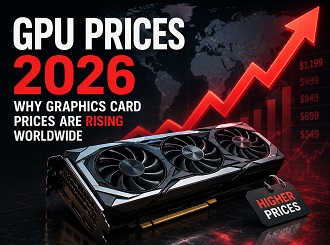
GPU Prices 2026: Why Are Graphics Cards So Expensive?
GPU prices have changed dramatically in 2026, with some graphics cards now selling well above their original launch prices. The biggest increases have been seen in higher-end NVIDIA GeForce RTX 50-series models, while AMD Radeon RX 9000-series cards have generally remained more competitive.
This is not being caused by one single problem. The current GPU price increase is the result of several factors coming together: strong AI infrastructure demand, a global memory shortage, higher prices for DRAM and NAND, limited manufacturing capacity, and the rising cost of producing graphics cards with larger amounts of high-speed memory.
For buyers in Lebanon, there is another factor to consider. Graphics cards are imported, so changes in international component prices can eventually affect local retail prices as well.
In this guide, we explain why GPU prices are rising in 2026, how AI is affecting the graphics hardware market, whether GPU prices are likely to fall, and whether you should buy a graphics card now or wait.
Why Are GPU Prices Rising in 2026?
The current GPU price increase is different from a normal product-generation cycle. New graphics cards often launch at a high price and become cheaper over time as supply improves and older models are discounted. In 2026, that pattern has been disrupted by a much broader memory and semiconductor supply problem.
1. AI Demand Is Putting Pressure on the Memory Industry
The AI boom is the biggest underlying force affecting the semiconductor market. The AI data centers require enormous quantities of high-bandwidth memory, server DRAM, storage, networking hardware, and advanced processors.
High-bandwidth memory (HBM) is not the same memory used on a typical gaming graphics card, but the two markets are connected through the global DRAM manufacturing industry. Samsung, SK hynix, and Micron are all directing substantial resources toward higher-value memory products used in AI systems.
That matters because memory manufacturers cannot instantly create new production capacity. When demand for AI-related memory grows faster than the industry can expand supply, manufacturers have to decide how to allocate limited capacity between different products and customers.
Samsung reported in July 2026 that its memory business was operating with limited capacity and that strong AI infrastructure spending was driving demand for HBM, server DRAM and enterprise SSDs. The company also said supply constraints were expected to continue despite efforts to increase production.
SK hynix reported a similar situation. Its second-quarter 2026 results showed significant increases in both DRAM and NAND prices, while the company said customer demand was exceeding its ability to supply the market.
The result is important for PC buyers: the AI boom does not need to consume gaming GPUs directly to affect gaming GPU prices. It can increase the cost and scarcity of the memory and semiconductor components used throughout the technology industry.
2. Memory Prices Are Now a Major Part of the Problem
One of the most important developments in the current GPU market is the increase in memory costs.
Latest graphics cards use dedicated video memory, commonly known as VRAM. Depending on the model, this can be GDDR6, GDDR6X or GDDR7. Higher-end graphics cards also require larger memory capacities and more expensive memory configurations.
The RTX 50-series, for example, introduced GDDR7 across much of NVIDIA's desktop lineup. The RTX 5070 has 12GB of GDDR7, the RTX 5080 has 16GB, and the RTX 5090 has 32GB.
When the underlying memory market becomes more expensive, the effect does not stay inside data centers. Graphics card manufacturers also have to pay more for the memory installed on consumer GPUs.
Micron's 2026 financial reporting provides particularly strong evidence of how serious the memory market has become. The company said AI-driven memory and storage demand was growing faster than industry supply, resulting in supply allocation decisions and significantly higher DRAM and NAND pricing.
3. The Cost of High-VRAM Graphics Cards Is Being Hit Hardest
Not every GPU is affected equally.
Graphics cards with larger amounts of VRAM are especially exposed to increases in memory costs because the memory itself represents a larger portion of the card's bill of materials.
This helps explain why some of the most dramatic price increases in 2026 have occurred on higher-memory NVIDIA models.
Recent market tracking has shown the RTX 5090 selling for several times its original $1,999 launch price in some markets. The RTX 5060 Ti 16GB has also experienced unusually large increases compared with its original $429 MSRP.
That does not mean every GPU has doubled in price. The market is much more uneven than that. Some lower-end and AMD models remain comparatively affordable, while premium NVIDIA cards have experienced much more severe inflation.
4. NVIDIA RTX 50-Series Prices Have Become Particularly Difficult
NVIDIA's GeForce RTX 50-series launched with official starting prices of $1,999 for the RTX 5090, $999 for the RTX 5080, $749 for the RTX 5070 Ti and $549 for the RTX 5070.
Those MSRPs provide a useful reference point, but they no longer represent what buyers necessarily have to pay in the current retail market.
Current price tracking shows that the gap between MSRP and actual retail pricing has become particularly large for some RTX 50-series models. The RTX 5090 has been hit hardest, but significant increases have also appeared lower in the product range.
This creates an unusual situation where a graphics card that was originally positioned as a mid-range or upper-mid-range product can sometimes cost close to what a substantially more powerful card would have cost earlier in the generation.
5. AMD Is Providing More Competition at Several Price Points
The GPU market is not uniformly expensive.
AMD's Radeon RX 9000 series has generally provided stronger price competition than NVIDIA's most heavily inflated models. AMD launched the Radeon RX 9070 XT at $599 and the RX 9070 at $549, both with 16GB of GDDR6 memory.
That makes AMD particularly relevant for buyers who care about gaming performance per dollar rather than a specific brand.
AMD's current Radeon RX 9000 lineup includes several options across the performance range, while NVIDIA's RTX 50-series remains particularly attractive for buyers who specifically want features such as DLSS, advanced ray tracing, CUDA-related workloads or NVIDIA's broader AI software ecosystem.
If you are currently shopping for a graphics card, you can browse the available GPUs and graphics cards at Options Megastore and compare the models currently available rather than relying only on launch MSRP.
How GPU Prices Are Affecting Gaming PCs
A higher graphics card price does not only affect people buying GPUs individually. It also changes the cost of complete gaming PCs.
Gaming PC Prices Are Rising Too
A graphics card can represent one of the largest costs in a gaming desktop. When GPU prices rise, system builders have several choices: increase the final PC price, reduce the graphics card specification, or reduce other components to keep the system within the same budget.
This is one reason some gaming PCs in 2026 can offer less RAM or storage than buyers might expect at a particular price level.
For someone building a complete system, it is therefore important to compare the total system price rather than looking only at the GPU.
Should You Build a PC or Buy a Pre-Built System?
There is no universal answer.
If individual graphics cards are heavily inflated but a pre-built gaming PC is available with a competitive overall price, buying the complete system can sometimes make more financial sense.
On the other hand, building your own PC gives you more control over the power supply, motherboard, cooling, storage, RAM and graphics card, and can make future upgrades easier.
If you are considering a laptop instead of a desktop, our gaming laptop vs gaming desktop comparison explains the main differences in cost, performance, portability and upgradeability.
How GPU Prices Affect Buyers in Lebanon
Lebanese buyers experience the global GPU market differently from buyers in countries with large local manufacturing industries.
Graphics cards sold in Lebanon are imported, meaning international component costs, distributor pricing, shipping, currency conditions and local operating costs all contribute to the final retail price.
This means a global increase in GPU costs can eventually appear in Lebanese stores, although the timing and size of the increase can vary depending on existing inventory.
Why Existing Stock Matters
A retailer does not necessarily pay today's international price for every graphics card currently on the shelf.
A card purchased earlier may have been imported at a lower cost, while a new shipment may have a substantially higher supplier price. This can create significant differences between the prices of similar GPUs at different times.
For buyers, this is why waiting for a specific GPU to become cheaper can sometimes work, but it can also backfire if the next shipment arrives at a higher cost.
Quick Summary: Why Are GPUs So Expensive in 2026?
| Factor | How It Affects GPU Prices |
|---|---|
| AI infrastructure demand | Increases demand for advanced memory and semiconductor capacity |
| HBM and server memory demand | Places pressure on global DRAM manufacturing capacity |
| Higher DRAM and NAND prices | Raises component costs across the technology industry |
| GDDR6/GDDR7 costs | Directly affects the cost of memory-equipped graphics cards |
| Limited manufacturing capacity | Makes it harder for supply to quickly catch up with demand |
| RTX 50-series price inflation | Creates particularly high prices for several NVIDIA models |
| Import and distribution costs | Can increase the final retail price in markets such as Lebanon |
Will GPU Prices Go Down in 2026?
This is the question most buyers want answered, and the realistic answer is: probably eventually, but there is no strong reason to expect a major market-wide price collapse in the immediate future.
The latest memory-industry results point toward continued demand pressure rather than a rapid return to excess supply.
Samsung expects strong server and AI-related memory demand in the second half of 2026 and says supply constraints are likely to continue. SK hynix is also expanding production capacity while reporting that demand currently exceeds available supply.
NVIDIA's own latest outlook also points toward continued AI infrastructure spending. The company has projected substantial revenue growth for its next fiscal year and said that memory-component shortages and higher costs are constraining how quickly it can expand.
Could GPU Prices Fall Later in 2026?
Yes. Individual models can still become cheaper.
GPU pricing is not controlled by the overall market alone. Retail competition, promotions, inventory levels, new product launches and the exchange rate between suppliers and distributors can all create temporary price drops.
For example, if a retailer has significant inventory of a particular GPU and demand slows, that model can receive a discount even while the broader memory market remains expensive.
Therefore, a temporary deal is much more realistic than expecting every graphics card to suddenly return to its original MSRP.
What About 2027?
2027 is more difficult to predict.
Additional semiconductor and memory capacity should eventually help the supply situation, but the AI infrastructure market is also continuing to expand. Samsung, SK hynix and Micron are investing heavily in additional capacity and next-generation memory products, but bringing new capacity online takes time.
For that reason, it would be premature to promise that GPU prices will return to launch MSRP across the board in 2027.
A more realistic expectation is that price relief will probably happen gradually and unevenly. Some GPU models may fall significantly while others remain expensive because of memory capacity, demand or limited production.
Should You Buy a GPU Now or Wait?
The right decision depends on what you need the graphics card for.
Buy Now If You Actually Need the Performance
- Your current GPU is preventing you from playing the games you want. Waiting indefinitely can leave you stuck with a system that no longer meets your needs.
- You need the GPU for work. Video editing, 3D rendering, AI development and other GPU-intensive workloads can justify buying sooner.
- You find a genuinely competitive price. A good deal on the right GPU is more important than waiting for an uncertain future MSRP reduction.
- You are building an entire PC. If the complete system is competitively priced, a pre-built system can sometimes offer better value than buying every component separately during a component shortage.
Wait If Your Current GPU Is Still Good Enough
- You only want a small performance improvement. There is less reason to pay inflated prices for a minor upgrade.
- You are buying a high-end GPU purely for future-proofing. Paying a large premium today may not be the best use of your budget.
- You are flexible about the brand. Comparing NVIDIA and AMD can reveal better value at different price points.
- You are not in a hurry. Retail promotions and changing inventory can create opportunities even when the overall market remains expensive.
How to Get Better GPU Value in 2026
1. Compare Performance, Not Just the Model Number
A newer or more expensive graphics card is not automatically the best purchase for your budget.
Look at the actual performance level you need for your resolution and games. A strong 1440p GPU may be a much better purchase than paying a huge amount for a premium card designed primarily for 4K gaming and specialized workloads.
2. Pay Attention to VRAM
VRAM capacity matters more than it did several years ago, particularly for latest games at higher resolutions and for some creative workloads.
However, more VRAM should not be treated as a reason to pay any price. The important question is whether the additional memory comes with enough performance and features to justify the higher cost.
3. Compare NVIDIA and AMD
The current market makes comparison particularly important.
NVIDIA has strong advantages in areas such as DLSS, ray tracing, CUDA and its wider AI software ecosystem. AMD's Radeon RX 9000 series can offer strong gaming performance and competitive memory capacities at lower prices in some segments.
Instead of deciding on a brand first, decide what performance, VRAM capacity and features you actually need and then compare the available cards.
4. Consider the Complete PC Budget
If the GPU takes too much of your budget, you may end up compromising on the CPU, power supply, RAM, storage or cooling.
A balanced gaming PC is generally a better investment than spending almost the entire budget on the graphics card and leaving the rest of the system underpowered.
If you are still deciding between a laptop and desktop, our gaming laptop vs gaming desktop guide can help you compare the two options before spending your budget.
GPU Price Outlook for 2026 and 2027
The current evidence suggests that the GPU market is dealing with a genuine supply and cost problem rather than a temporary shortage affecting only one graphics card.
AI infrastructure is driving extraordinary demand for high-bandwidth memory and server hardware. At the same time, major memory manufacturers are reporting strong demand, rising memory prices and constrained supply.
Those conditions create an unfavorable environment for consumer graphics cards, particularly models that require large amounts of expensive VRAM.
However, that does not mean every GPU will continue getting more expensive indefinitely. The market is already showing major differences between models, with some AMD and lower-priced graphics cards remaining considerably more accessible than the most inflated NVIDIA models.
For buyers in Lebanon, the smartest strategy is therefore not simply to wait for a specific date when “GPU prices will drop.” Instead, compare the actual performance you need, the current local price, available alternatives and the total cost of your PC.
If your current system still performs well, waiting for a genuinely good deal can make sense. If you need the performance now, a carefully chosen graphics card at a reasonable current price is often better than waiting months for a price drop that may never arrive.
For current availability and pricing, see the GPU and VGA graphics card section at Options Megastore.
Frequently Asked Questions About GPU Prices in 2026
Why are GPU prices so high in 2026?
GPU prices are being affected by several factors, including strong AI infrastructure demand, higher DRAM and NAND prices, limited memory manufacturing capacity, expensive GDDR memory and higher production costs. NVIDIA's RTX 50-series has experienced particularly significant price increases in 2026.
Is AI making gaming GPUs more expensive?
AI is an important indirect factor. AI systems primarily use specialized data-center accelerators and high-bandwidth memory rather than simply buying large quantities of consumer gaming GPUs. However, AI demand is putting pressure on the wider semiconductor and memory supply chain, which can increase the cost and availability of components used in consumer graphics cards.
Will RTX 50-series prices go down?
Individual RTX 50-series models can certainly receive discounts, especially when retailers need to clear inventory. However, the broader memory shortage means there is currently no strong evidence that the entire RTX 50-series will quickly return to its original launch MSRPs.
Are AMD GPUs cheaper than NVIDIA GPUs in 2026?
In several current-generation segments, AMD Radeon RX 9000-series cards have remained more competitively priced than comparable NVIDIA RTX 50-series models. The best choice still depends on the specific GPU, game, resolution and features you need.
Should I buy a GPU now or wait?
If your current GPU is still performing well, waiting for a good promotion can make sense. If you need more performance now, focus on finding the best-value model available rather than waiting indefinitely for the entire market to return to MSRP.
Where can I buy graphics cards in Lebanon?
You can check the GPU and VGA section at Options Megastore for currently available graphics cards and compare the options for your budget and performance requirements.